Safety first. The following information is for educational purposes. CNC machining involves high-speed rotating cutters. Always wear eye and ear protection, never leave a running machine unattended, and verify all feeds and speeds for your specific setup.
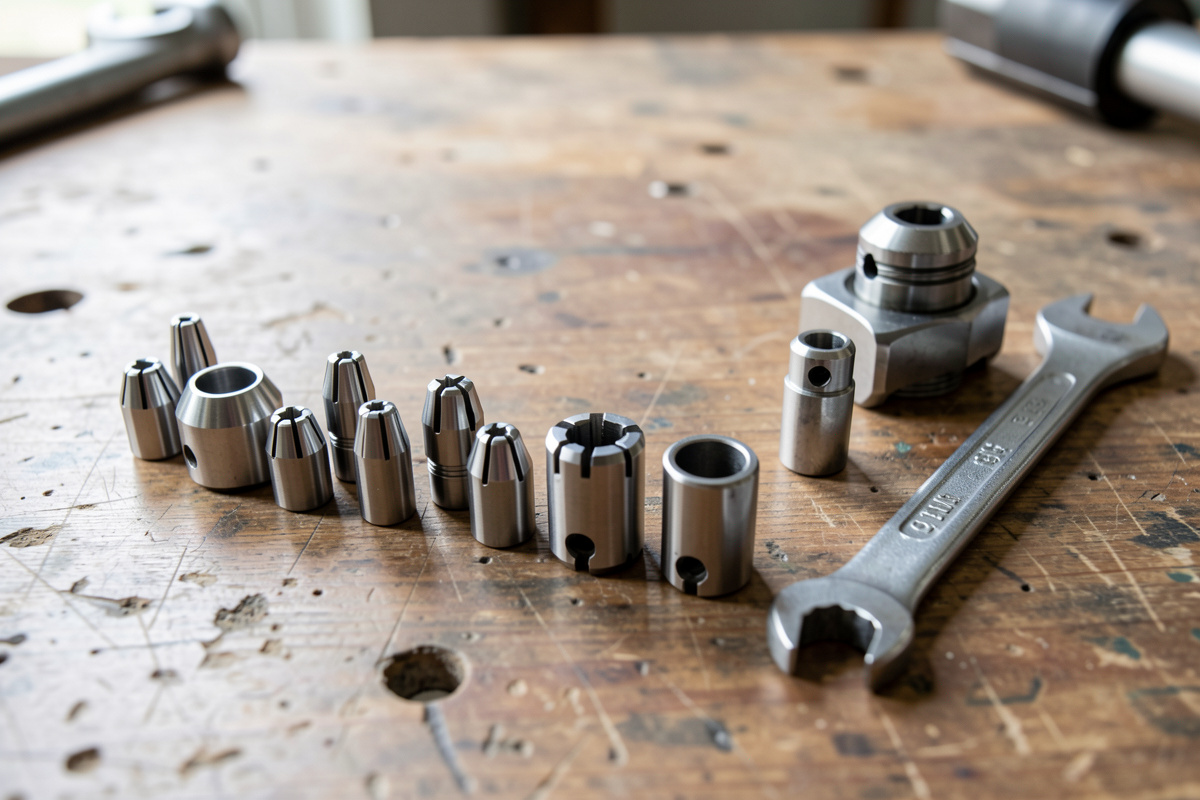
An ER collet is the slotted, tapered sleeve that grips your tool shank inside a VFD spindle, and it does more for finish and tool life than most people credit. The size you need follows your spindle: ER11 for small 0.8kW spindles up to a 1/4″ shank, ER16 and ER20 for larger spindles and tooling up to 1/2″. Each collet clamps a 1 mm range, so you match the collet to the exact shank, not a near-miss.
Most runout problems I have chased on the bench were not the spindle — they were a wrong, dirty, or badly seated collet. Picking the right ER size and using it correctly is cheap insurance against oversized cuts and broken bits. This guide covers the sizes, the 1 mm matching rule, imperial versus metric collets, the seating mistake almost everyone makes, and which collets to buy first. It sits under the CNC spindle and router guide and pairs with the router bits guide, since the collet and the bit are one system.
What an ER collet is and the sizes
The ER system is a standardized series of collets named ER11, ER16, ER20, ER25, and ER32, where the number relates to the body diameter and the maximum bore. The series is defined by the DIN 6499 (ISO 15488) standard, which is why an ER20 collet from one maker drops straight into an ER20 nut from another. ER11 holds up to about 7 mm, ER16 up to 10 mm, ER20 up to 13 mm, and the bigger ones beyond that. Your spindle determines which series you have — it is set by the spindle nose taper and nut, not a choice you make per job.
Small 0.8kW 65mm spindles almost always use ER11, which comfortably holds the 1/8″ and 1/4″ tooling most hobby work needs. Step up to a 1.5kW or 2.2kW spindle and you typically get ER16 or ER20, which adds headroom for 3/8″ and 1/2″ shanks. You buy collets within whatever series your spindle uses; you do not mix series. Once you know your series, the only decision left is which individual collet sizes to stock.
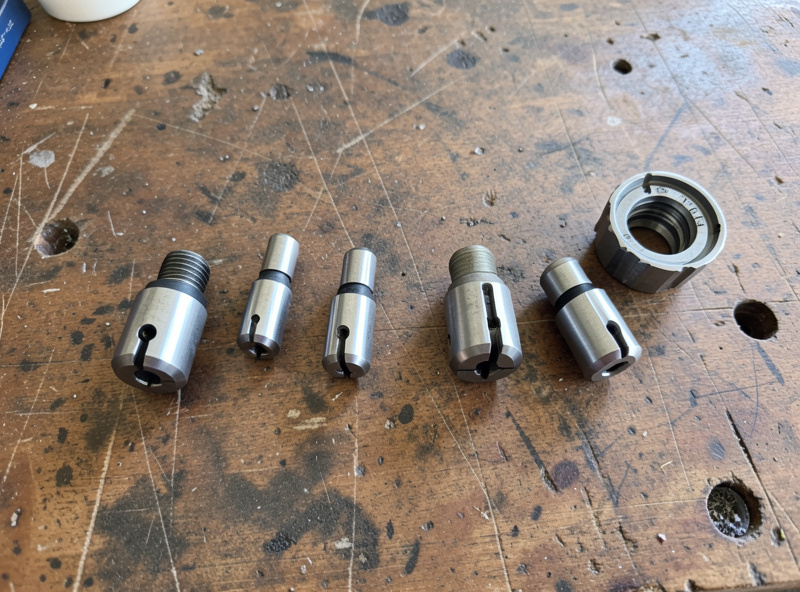
The 1 mm rule: match the collet to the shank
This is the rule that trips people up: each ER collet clamps a range of just 1 mm, and it must compress to grip. A collet is named by the top of its range, so a “7 mm” collet holds shanks from 6 mm to 7 mm and grips a 1/4″ shank (6.35 mm) perfectly. A “4 mm” collet holds 3 mm to 4 mm and grips a 1/8″ shank (3.175 mm). You pick the collet whose 1 mm window contains your exact shank.
The failure is forcing a shank into the wrong window. A 6.35 mm shank will not seat in a “6 mm” collet, whose range tops out at 6 mm, and dropping a 3 mm shank into a “7 mm” collet leaves it gripping on the very edge of its range with terrible runout, if it grips at all. Buy the collet that brackets the shank, and the grip is concentric and secure. Get this wrong and no amount of spindle quality saves your finish — the runout is built in before the spindle even turns. Measuring that runout is covered in spindle runout and bearing maintenance.
Imperial vs metric collets
Tooling comes in both 1/4″ and 6 mm, 1/8″ and 3 mm, and the difference is small but real. A 1/4″ shank is 6.35 mm and a 6 mm shank is 6.0 mm — a “7 mm” metric collet can hold the 1/4″ shank near the middle of its range, but a dedicated 1/4″ imperial collet, ground specifically for 6.35 mm, gives lower runout because the shank sits at the collet’s design center rather than off to one side.
For most hobby work, metric collets that bracket your imperial shanks are fine, and the runout difference is negligible at the chiploads we run in wood and plastic. But for the tools where runout matters most — small bits, fine V-carving, finishing passes in aluminum — a dedicated imperial collet for your common 1/4″ and 1/8″ shanks is worth owning. Know which shanks your tooling actually uses before you buy; mixing imperial bits and metric collets blindly is how people end up with a collet that grips on its edge. The tooling side of this is in CNC end mills and CNC V-bits.
As an Amazon Associate I earn from qualifying purchases. A boxed ER collet set in your spindle’s series is the cheapest way to cover the common shank sizes at once and stop improvising.
Seat the collet right, or build in runout
Here is the mistake almost everyone makes, and it has nothing to do with which collet you bought. You must snap the collet into the eccentric ring inside the nut first — tilt it in at an angle until it clicks into the ring — then thread the nut and collet together onto the spindle a few turns, and only then insert the tool and tighten. The collet has to be captured by the nut before it goes on the spindle.
If you drop the collet into the spindle taper and then try to thread the nut over the tool, the collet never pulls true and you get runout and a weak grip every time. I did exactly this when I first fitted the air-cooled VFD spindle on my Shapeoko Pro — dropped the collet into the taper, threaded the nut down over the bit, and chased phantom runout for a week before I learned the sequence. People do this for months and blame the spindle. Once the collet snaps into the nut correctly, tighten with the proper wrench — firm, not gorilla-tight, because overtightening damages the collet and actually worsens runout. The seating sequence is the single highest-value habit in this whole guide.
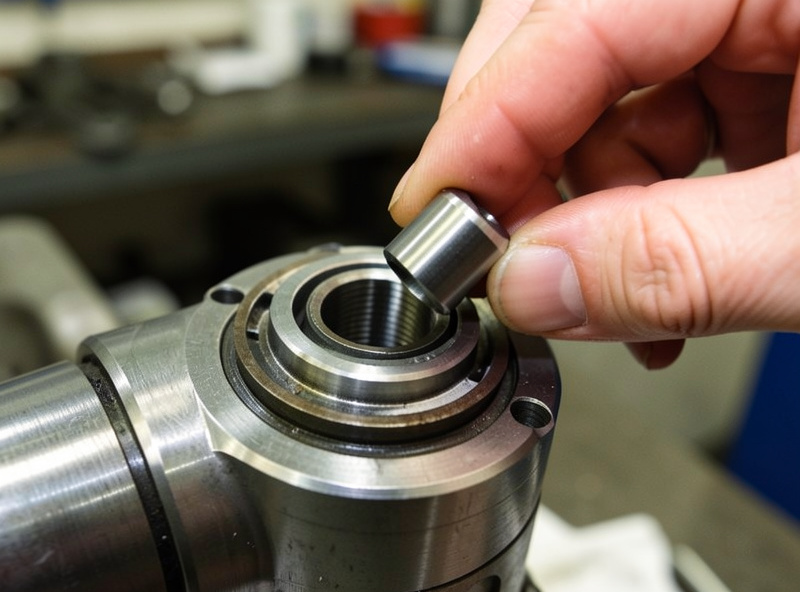
Keeping collets true
Clean is concentric. Grit, dust, or chips in the collet slots, the taper, or the spindle nose throw the tool off axis just as surely as a worn collet, so wipe the collet, the bore, and the spindle taper before every tool change. A collet packed with fine MDF dust will never run true no matter how carefully you seat it, and that dust gets everywhere, which is why dust collection is a cut-quality issue, not just a lung one.
Insert enough shank that most of the collet length grips, but do not bottom the bit hard against the base of the bore — leave a small gap so the collet compresses on the shank, not on the tool tip. Treat collets as consumables: a dropped, dinged, or visibly worn collet gets replaced, because a damaged one quietly ruins every cut after. Store them in their case, not loose in a drawer where they collect grit. Do these few things and a modest spindle holds runout under about 0.01 mm at the collet, which is all most hobby work ever needs.
| ER series | Max bore | Typical spindle | Common shanks held |
|---|---|---|---|
| ER11 | ~7 mm | 0.8kW 65mm | 1/8″, 3 mm, 1/4″, 6 mm |
| ER16 | ~10 mm | 1.5kW | 1/8″ to 3/8″, 3–10 mm |
| ER20 | ~13 mm | 1.5–2.2kW | 1/8″ to 1/2″, 3–13 mm |
| ER25 | ~16 mm | 2.2kW+ | Up to 5/8″, 16 mm |
| ER32 | ~20 mm | Larger/industrial | Up to 3/4″, 20 mm |
Which collets to buy first
Do not buy the full set on day one. Stock the collets your actual tooling uses, which for most hobbyists in the ER11 or ER20 world means the sizes that bracket 1/8″ and 1/4″ shanks — those two cover the vast majority of router bits, end mills, and V-bits. Add a 6 mm and 3 mm collet if you run metric tooling, and a dedicated imperial collet for the finishing tools where runout matters.
From there, expand only as your tooling does. A 3/8″ or 1/2″ collet earns its place when you start running bigger surfacing or roughing bits; until then it sits in the case. Buying to your tooling instead of buying a wall of collets keeps your money where it helps and your bench uncluttered. Pair the right collet with the right bit and a true setup, and the whole cut comes together — the broader logic is in the router bits guide and the router vs spindle comparison.
Frequently Asked Questions
What ER collet size does my spindle use?
It depends on the spindle, not the job. Small 0.8kW 65mm spindles almost always use ER11, which holds up to about 7mm. Larger 1.5kW and 2.2kW spindles typically use ER16 or ER20, holding up to 10mm and 13mm respectively. You buy collets within your spindle’s series.
Can a metric ER collet hold an imperial bit?
Yes, within its 1mm range. A 7mm collet holds a 1/4-inch shank (6.35mm) near the middle of its range. For tools where runout matters most, a dedicated 1/4-inch imperial collet ground for 6.35mm gives lower runout than a metric collet holding it off-center.
How do I install an ER collet correctly?
Snap the collet into the eccentric ring inside the nut first, tilting it until it clicks. Then thread the nut and collet onto the spindle a few turns, insert the tool, and tighten firmly with the proper wrench. Putting the collet in the spindle before the nut builds in runout.
Should I bottom the bit out in the collet?
No. Insert enough shank that most of the collet length grips, but leave a small gap at the base so the collet compresses on the shank, not on the tool tip. Bottoming the bit hard prevents the collet from gripping properly and can cause slipping.
Why does my bit run with high runout in a good spindle?
Usually the collet, not the spindle. A wrong-size collet gripping at the edge of its range, a dirty collet or taper packed with dust, a damaged collet, or a bit seated before the collet was snapped into the nut all build in runout. Clean and reseat before blaming the spindle.