Safety first. The following information is for educational purposes. CNC machining involves high-speed rotating cutters. Always wear eye and ear protection, never leave a running machine unattended, and verify all feeds and speeds for your specific setup.
An enclosure is the upgrade nobody puts on their CNC wishlist and half of us end up building anyway. It isn’t a bit, it isn’t a spindle, and it won’t make a single cut more accurate. What it changes is everything around the cut — how loud the machine is, where the dust ends up, and whether a curious hand or a tail-wagging dog can reach a spinning cutter. Whether you actually need one comes down to your machine, your space, and your life, not to a rule that everyone with a router must box it in.
I run my machines in a Sweden workshop that the welder, the laser cutter, and the 3D printer all share, and that shared space is exactly why the enclosure question got real for me. The same room that needs fume discipline for the welder and dust discipline for the sander does not love an open router screaming chips across the bench at 22:00. This is the honest version of the decision — the three reasons that justify an enclosure, the trade-offs that talk people out of one, and how to actually build a useful box if you land on yes.
A quick note: some links below are affiliate links. Buy through one and I may earn a small commission at no extra cost to you. I only point to materials I’d actually line my own enclosure with — details on my disclaimer page.
The Three Reasons an Enclosure Earns Its Space
Strip the enclosure conversation down and there are exactly three problems it solves, in roughly this order of how often they drive the decision: noise, dust, and safety. Most people start chasing one of them and discover the box handles all three at once, which is what makes it tempting despite the bulk.
Noise is the one that usually tips the scales. A trim router screaming through hardwood, the shop-vac roaring alongside it, and the gantry rattling out a contour pass together make a sound that fills a house. If your machine lives in a garage detached from where anyone sleeps, this may be a non-issue. But if it shares a wall — or a floor — with a bedroom, the difference between an open machine and an enclosed one is the difference between “I can only cut on Saturday afternoons” and “I can run a long job after the kids are asleep.” For a hobbyist whose shop time comes at unsociable hours, that one change is worth the entire build.
Dust is the second reason, and it’s the one people misunderstand. A good dust boot at the spindle captures most of the chips — but most is not all. Plunge moves, the instant the boot lifts to clear a clamp, ramping cuts, and the fine MDF dust that a boot was never going to catch all escape into the room. An enclosure is the backstop that contains what the boot misses, instead of letting it settle on every flat surface in the shop. In my shared space that matters double, because fine wood and MDF dust drifting onto the welding bench or the printer’s print surface is its own small problem.
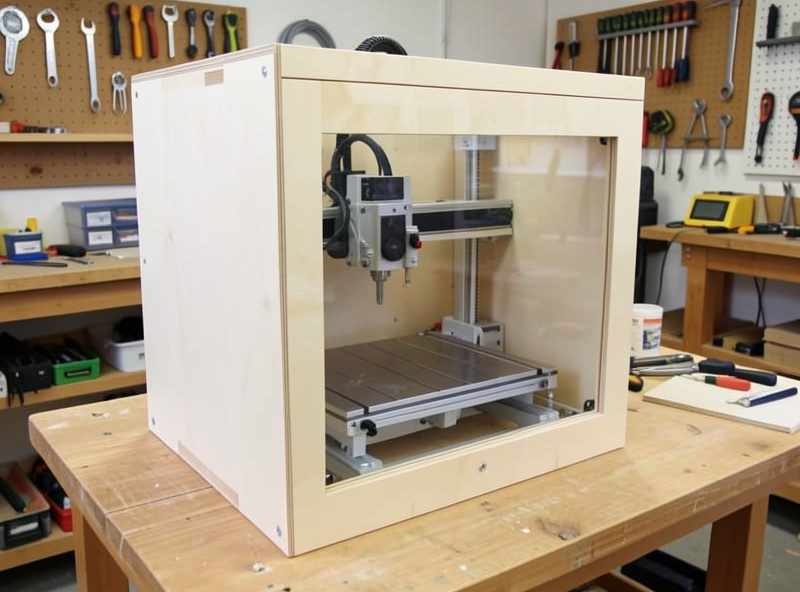
Safety is the third, and it’s the quiet one. A desktop CNC looks tame next to a table saw, but a spinning end mill at 18,000 RPM will not negotiate with a finger, and a machine that throws a bit or grabs a loose part can fling it across the room. An enclosure is a physical barrier between that cutter and everything you’d rather it didn’t reach — your hands when you instinctively go to brush a chip away, a child who wanders in, a cat who thinks the moving gantry is a toy. I treat the box as one layer of a broader habit set I lay out in my safe desktop CNC workshop guide; it doesn’t replace good practice, but it forgives the one moment of inattention that good practice can’t always cover.
The Trade-Offs Nobody Mentions in the Build Videos
The enclosure videos are full of beauty shots and quiet running. What they skip is everything the box costs you, and those costs are real enough that I’d talk some people out of building one entirely.
The first is bulk. An enclosure roughly doubles the footprint and the height your machine demands, because you need clearance for the gantry’s full travel plus the wall thickness plus a window that opens. A compact desktop router that tucked onto a corner of the bench becomes a wardrobe-sized object. In a small shared shop that’s a genuine sacrifice — that’s volume the welder or the printer no longer gets.
The second is access. Every time you change a bit, re-zero, swap workholding, or peer at a cut, the enclosure is in the way. A hinged front or a lift-up panel helps, but you’re still reaching past walls instead of working in open air. If your workflow involves a lot of fiddly setups — and most of mine do, because workholding is never one-and-done — the access tax adds up across a session.
The third is heat. A sealed box around a spindle and a controller traps heat, and a hot VFD or a warm stepper driver is a shorter-lived one. This is why ventilation isn’t optional on a real enclosure — you can’t just seal the machine in a coffin and walk away. The fourth is dust extraction from inside the box: contain the dust and you’ve also contained it away from your shop-vac unless you route collection through the enclosure deliberately. And the fifth is simply cost and time — a proper sound-rated build with mass-loaded vinyl and a polycarbonate window isn’t a free weekend, and the materials add up.
What to Build It From, and Why
If you’ve weighed all that and still want the box, the materials divide cleanly by which problem each one solves. The mistake I see most is people treating “enclosure” as one thing when it’s really a sandwich of layers, each doing a different job.
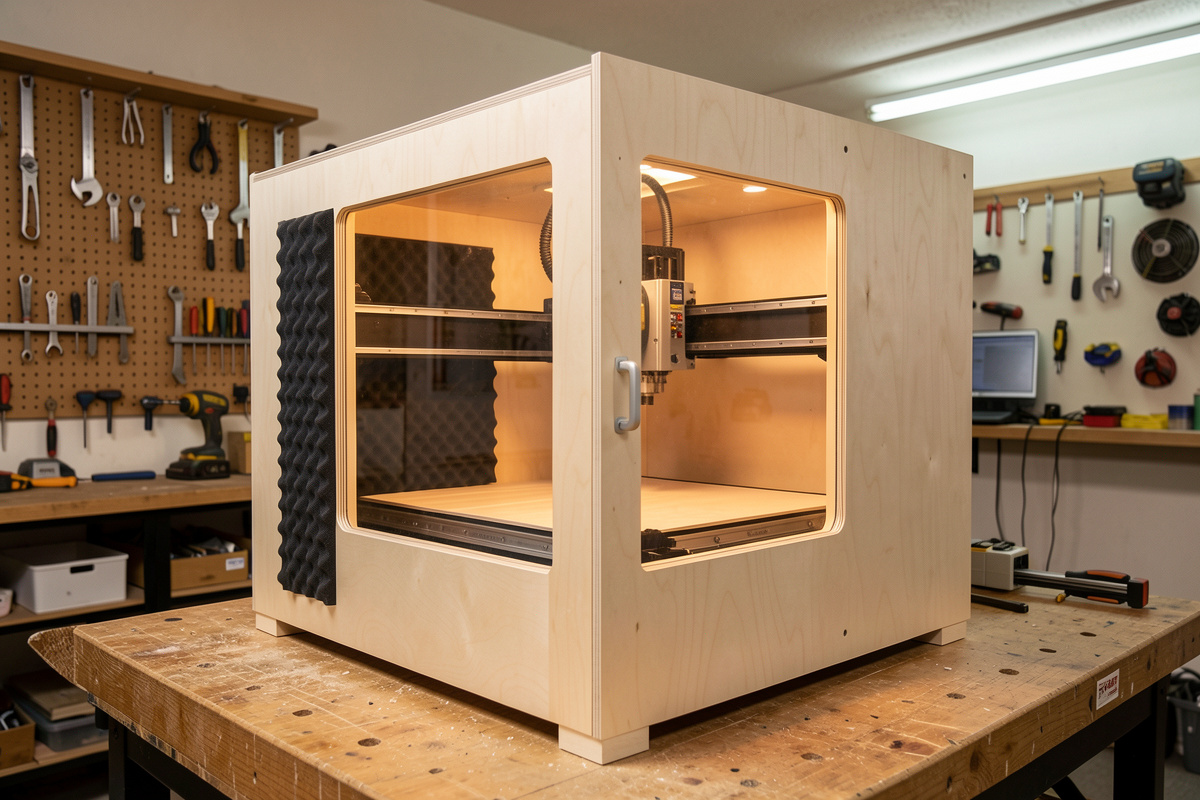
For structure, plywood is the default and it’s the right one — 12mm to 18mm ply is rigid, easy to cut on the very machine you’re enclosing, and a sane base for everything else. MDF works too and is a touch denser for sound, but it’s heavier and hates moisture. The structure alone knocks down a surprising amount of noise simply by being a solid wall between the machine and your ears.
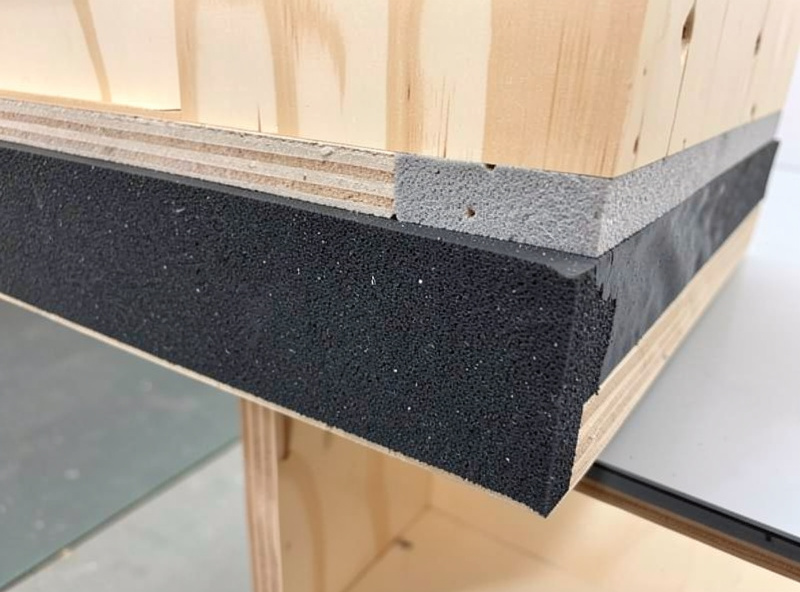
For serious noise control, the structure isn’t enough — you add mass and absorption. Mass is what blocks low-frequency sound, and the cheapest effective mass is mass-loaded vinyl soundproofing — a dense, limp sheet you sandwich between the ply and an inner liner. It’s the single most effective sound material per dollar for a build like this, and it’s the same logic the welder’s and the laser’s noise gets the benefit of when the whole shop runs quieter. On top of the mass you add absorption to kill the ringing and reflection inside the box, and that’s where acoustic foam panels earn their place — they don’t block sound the way mass does, but they soak up the high-frequency whine that makes a router so piercing.
For the window, you want to see the cut without losing the sound barrier, and that means a real pane, not an open hole. A clear polycarbonate sheet is the right call over acrylic here — polycarbonate is dramatically more impact-resistant, and on the off chance the machine ever throws a bit or a part at the window, you want the material that won’t shatter. A 4mm to 6mm sheet gives you a clear view, a meaningful sound barrier, and a face that shrugs off the occasional flung chip.
Ventilation and Dust: Getting Air and Chips Out Without Letting Noise Out
This is the part that separates a box that works from one that cooks your spindle and clogs with chips. You have to move air and remove dust through the enclosure, and every opening you cut is a leak for sound. The trick is making those openings do their job while leaking as little noise as possible.
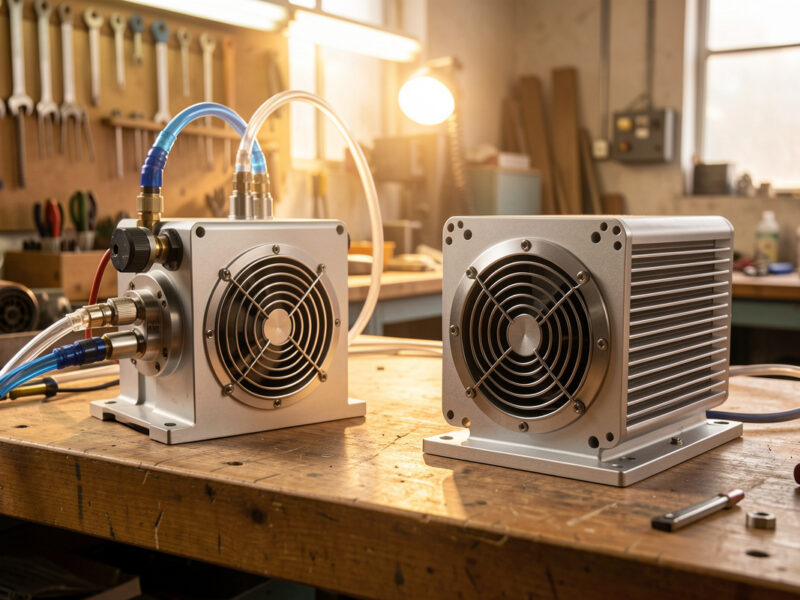
For ventilation, a small computer-style fan pulling warm air out one side, with a baffled intake on the other, keeps the internal temperature sane without opening a straight acoustic path to your ears. The baffle — a short lined duct that air turns a corner through — is what lets sound die in the bends while air keeps flowing. Don’t skip this. A spindle and controller in a sealed box will run hot, and heat is the enemy of both.
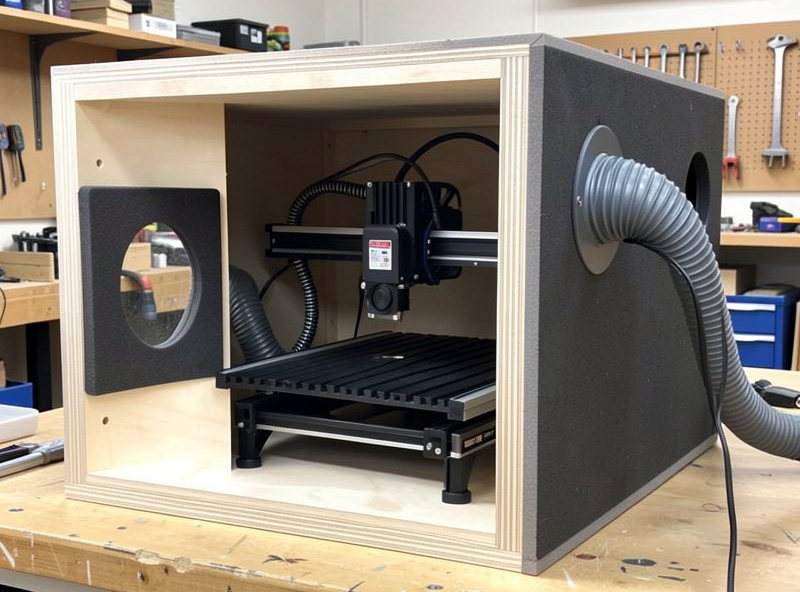
For dust, the cleanest approach is to keep your existing dust boot and shop-vac doing their job and run the hose through a sealed grommet in the enclosure wall, so collection happens at the cutter as it always did and the box just contains the overflow. The vacuum’s airflow also helps vent the box slightly, which is a bonus. If you run a cyclone-and-shop-vac setup like mine, nothing about that changes except where the hose passes through. The enclosure is the backstop, not the primary collector — the boot is still doing the heavy lifting, the same way it does when I’m chasing a clean finish and fighting recut chips that wreck the surface.
When an Enclosure Is Not Worth It
Here’s the part the enclosure evangelists won’t tell you: plenty of setups are better off without one. If you have a dedicated shop — a detached garage, a basement room with a door, a space where noise and dust bother no one — an enclosure is mostly solving problems you don’t have. You get the bulk and the access tax for a noise benefit nobody needed.
The same goes for infrequent use. If you fire up the machine a few times a month for short jobs, the hours you’d sink into building and the bench space you’d give up rarely pay back against the handful of times the box would’ve helped. A good dust boot, hearing protection, and the discipline to run loud jobs at reasonable hours cover a lot of ground for free. And if your machine is a compact unit you’d have to fully box in to enclose at all, the geometry may simply not be worth fighting.
Run yourself through this quick checklist before you commit the weekend:
- Does the machine share a wall or floor with where people sleep or relax? If yes, noise alone may justify it.
- Do you want to run long jobs at unsociable hours? The enclosure is what makes that socially possible.
- Are there kids, pets, or shared-shop traffic near the machine? The safety barrier earns its keep.
- Do you have the floor and height to spare? If the box would crowd out other tools, weigh that honestly.
- Do you cut often enough to amortise the build? Frequent use pays it back; a few jobs a month rarely does.
- Is your dust boot already doing most of the work? If collection is dialled in, the enclosure is a smaller win.
Two or more strong yeses and I’d build it. Mostly noes and I’d put the time into a better dust boot and a good set of ear defenders instead. The shared-workshop angle is what pushed me over the line — the same room running the welder, the laser, and the printer benefits from one machine being quiet and contained, the same way the whole shop runs on one shared dust-and-fume discipline rather than four separate ones. If you’re standing up a new shop from scratch, it’s worth designing the enclosure question in alongside the rest of the bench, the way I think about the complete CNC workflow from CAD through to the finished part. And the box pairs naturally with picking a machine that suits the space — something I weigh in the best desktop CNC roundup when footprint is a constraint.
Frequently Asked Questions
Do I really need a CNC enclosure?
Not always. An enclosure earns its space when your machine shares a wall or floor with living areas, when you want to run long jobs at unsociable hours, or when kids and pets are near a spinning cutter. If you have a dedicated shop and cut infrequently, a good dust boot and hearing protection often cover it for free.
How much does a CNC enclosure reduce noise?
A solid plywood box alone knocks down a meaningful amount just by being a wall. Adding mass-loaded vinyl to block low frequencies and acoustic foam to absorb the high-frequency whine takes it from house-filling to background level, often enough to run a job after the household is asleep.
What is the best material for a CNC enclosure?
Build the structure from 12mm to 18mm plywood. For noise control, sandwich mass-loaded vinyl between the ply and an inner liner, then add acoustic foam to absorb high frequencies. Use a 4mm to 6mm polycarbonate sheet for the window since it resists impact far better than acrylic.
Will an enclosure make my CNC overheat?
It can if you seal it completely. A spindle and controller in a closed box trap heat, so ventilation is mandatory. A small extraction fan with a baffled intake moves warm air out while the baffle lets the sound die in the bends, keeping temperatures safe without opening a straight acoustic path.
How do I handle dust collection inside an enclosure?
Keep your dust boot and shop-vac doing the primary collection at the cutter and run the hose through a sealed grommet in the enclosure wall. The box becomes a backstop for what the boot misses rather than the primary collector, and the vacuum airflow helps vent the box slightly.