Safety first. The following information is for educational purposes. CNC machining involves high-speed rotating cutters. Always wear eye and ear protection, never leave a running machine unattended, and verify all feeds and speeds for your specific setup.
Holding small parts on a CNC is the workholding problem that defeats every standard method at once. A part too small to clamp safely, too little area to hold under vacuum, and too fiddly to load in a vise is exactly the kind of job that ends with a launched part and a snapped bit. I’ve lost enough tiny parts across the shop to have worked out a reliable playbook, and it comes down to a handful of techniques matched to just how small and how delicate the part is. None of it is exotic — it’s the same five workholding families bent to fit parts the textbook setups can’t grip.
This is how I hold the parts nothing else will, sitting alongside the broader method choices in my CNC workholding guide. The deep dives on tape and CA glue, the vise with soft jaws, and tabs and onion skinning each play a role in the small-parts toolkit.
A quick note: some links below are affiliate links. Buy through one and I may earn a small commission at no extra cost to you. I only point to gear I’d actually hold a small part with on my own bench — details on my disclaimer page.
Why Small Parts Are So Hard to Hold
Every workholding method scales with size, and small parts fall below the threshold where most of them work. Clamps need somewhere to grip that isn’t the area you’re machining, and on a tiny part there’s nowhere to put one. Vacuum hold equals pressure times area, and a small part has almost no area, so the hold is negligible. A vise can grip a small block, but loading a delicate part precisely into jaws is fiddly and the jaws may crush it. Meanwhile the cutting forces don’t shrink proportionally — a small part can see nearly the same lateral load as a big one, with far less hold resisting it.
The result is that small parts demand methods that grip the whole footprint from below or keep the part attached to larger stock. That’s why adhesive holds and cut-strategy holds dominate the small-parts playbook, while clamps and vacuum mostly step aside. The mental shift is to stop trying to hold the small part directly and instead hold something bigger that the part is part of, or bond it down across its whole base.
Cut the Small Part From Larger Stock
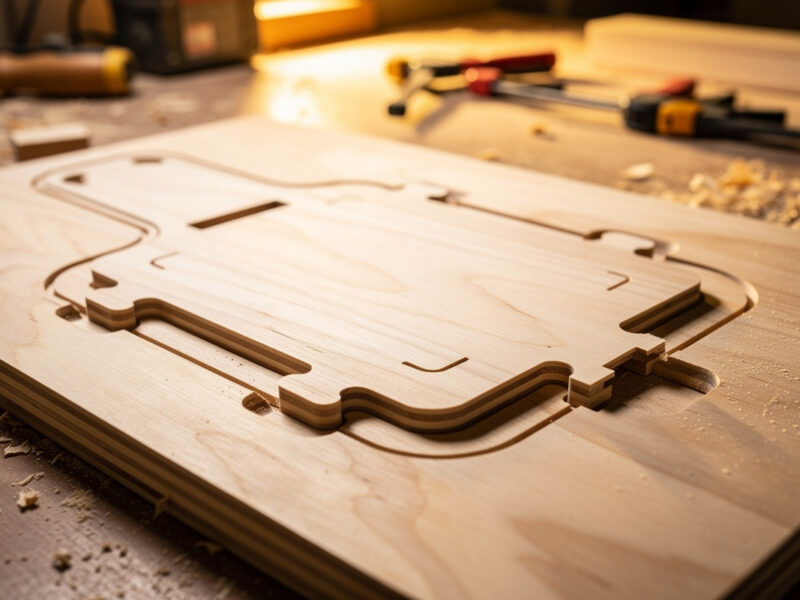
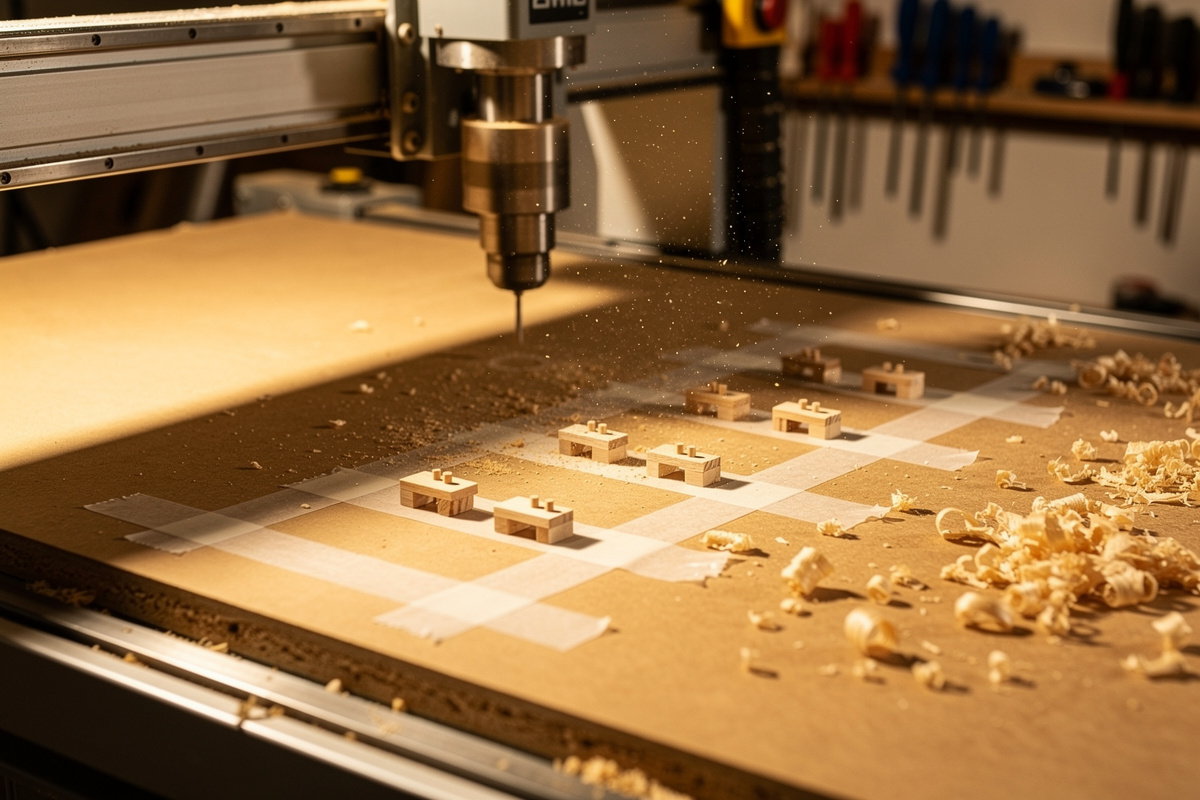
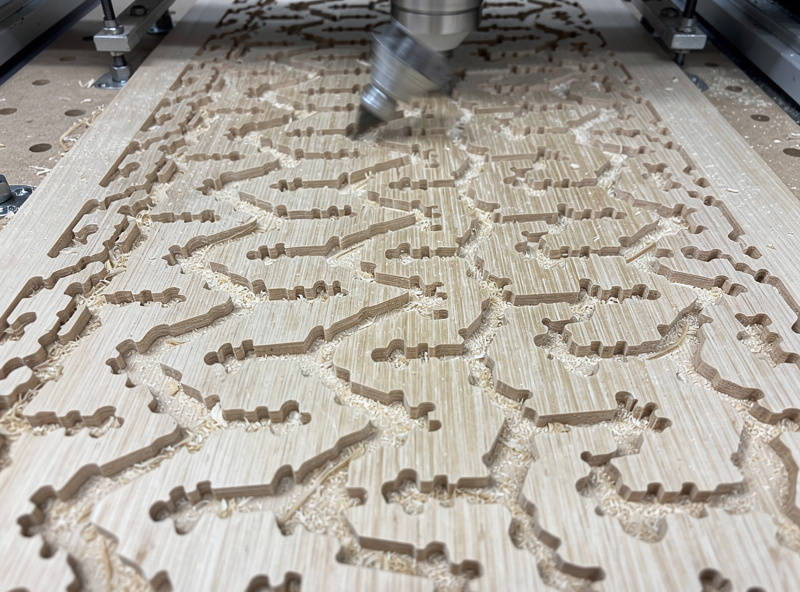
The single best small-parts strategy is to never have a loose small part during the cut at all. Start with a larger sheet or block you can hold solidly — clamped, taped, or vacuumed — and machine the small parts out of it, leaving them attached by tabs or an onion skin until the program finishes. The big stock takes the hold; the small parts stay connected to it until you choose to free them after the spindle stops. This is how I make a batch of tiny parts safely: hold the sheet, profile the parts with generous tabs, then snap them out by hand.
This approach turns an impossible holding problem into an easy one, and it’s why tabs and onion skinning are central to small-part work. Onion skinning especially suits delicate small parts because the thin floor holds gently across the whole footprint rather than at a couple of stress-concentrating tab points. Size the tabs or skin to be just strong enough to survive the cut and easy to remove, and a dozen fragile parts come off the machine intact.
Adhesive Holds for Genuinely Small Parts
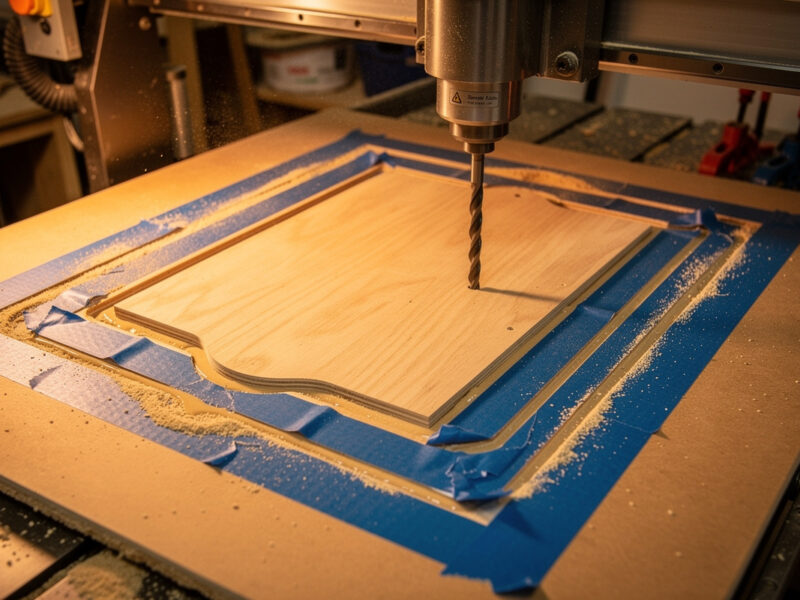
When a part must be machined as an individual piece — not cut from a sheet — adhesive is usually the answer. Double-sided tape holds small flat parts across their whole base for light cuts, and the full-footprint contact gives more hold than its small area suggests. For anything more aggressive, the painter’s tape and CA glue method scales down beautifully: the bond is strong, distributed, and releases clean, which is exactly what a small part needs. A roll of heavy double-sided CNC tape handles the light jobs, and a bottle of thin CA glue with accelerator covers the demanding ones.
The key with small adhesive holds is surface prep and pressure. Clean the back of the part and the spoilboard so the adhesive grips fully, and press hard — a small part has so little area that any loss of contact matters enormously. For a part with an awkward base, a dab of hot glue around the edges can supplement tape for light cuts, releasing later with a little heat. The smaller the part, the more every square millimetre of contact counts, so I never rush the stick-down step.
Soft Jaws and Fixtures for Small Repeat Parts
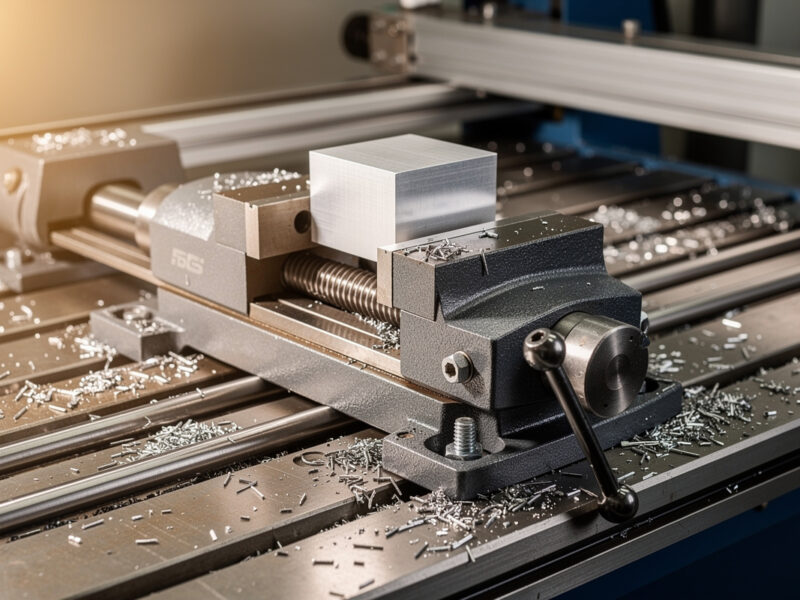
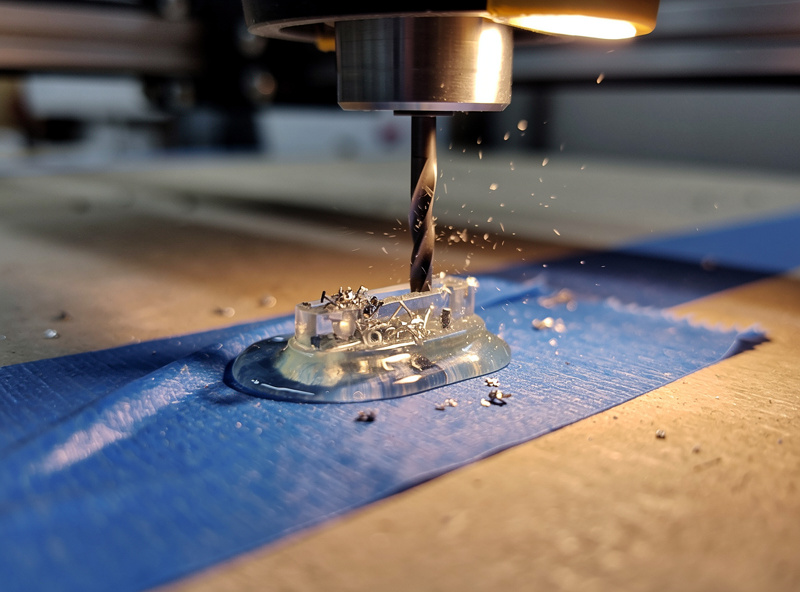
For small parts you make repeatedly — and especially small metal parts — a fixture beats fighting the hold every time. Soft jaws machined to cradle the part turn a vise into a foolproof loader: the part drops into its pocket, grips on multiple faces, and locates identically every run. For non-vise work, a fixture plate with a milled pocket or locating pins does the same job on the bed. The fixture takes a little time to make, but it pays back instantly on a batch — every part loads the same way and holds the same way, with no per-part fiddling.
This is the small-parts version of the fixture thinking that runs through all my workholding. A pocket cut to the part’s outline, a couple of locating pins, or contoured soft jaws each solve “how do I hold this little thing the same way fifty times” — and the machine makes its own fixtures, cutting the cradle on the same CNC that will hold the parts. For the broader fixture-versus-print decision, the jigs and fixtures comparison covers when each process wins, and the vise guide details cutting soft jaws.
A simple fixture trick I lean on for small flat parts is a pocket-and-pin plate: mill a shallow pocket the exact outline of the part into a fixture board, drop the part in, and it can’t shift sideways — then a strip of tape or a tiny toe clamp on the edge holds it down. The pocket does the locating, the tape or clamp does the holding, and loading the next part is instant. For parts with a hole already in them, a single locating pin through that hole plus a low-profile hold-down is even faster. A set of small low-profile low-profile hold-down clamps is worth keeping for exactly these edge-grip situations, where a full step clamp would be far too big for the part.
Small-Part Mistakes to Avoid
The errors that cost me parts early on are easy to name now. Trying to clamp a part too small for a clamp to clear the cut is the first — there’s simply nowhere to put the clamp, so the answer is a different method, not a smaller clamp jammed in. Trusting vacuum on a small part is the second; the area math just doesn’t work, and the part shifts the moment a cut loads it sideways. Under-pressing adhesive is the third — on a tiny footprint, a poorly stuck part has almost no margin, so the stick-down step is not where to rush.
The biggest single lesson, though, is to default to cutting small parts from larger stock whenever the geometry allows. It sidesteps the whole holding problem: the part is never loose while the cutter is running, the big stock takes an easy hold, and you release the parts by hand in safety. When I catch myself trying to directly hold something tiny, the first question I ask is whether I could instead leave it attached to a sheet with tabs and skip the fight entirely. More often than not, I can.
Small-Part Holds Compared
| Method | Best for | Hold | Notes |
|---|---|---|---|
| Cut from larger stock (tabs/skin) | Batches of small flat parts | High | Safest; part never loose during cut |
| Double-sided tape | Small flat parts, light cuts | Low-medium | Press hard, clean surfaces |
| Tape + CA glue | Small flat parts, aggressive cuts | High | Releases clean; flat parts only |
| Soft jaws / fixture | Small repeat parts, metal | Very high | Setup cost, pays off on batches |
Frequently Asked Questions
How do you hold small parts on a CNC?
The safest way is to cut small parts from larger stock you can hold solidly, leaving them attached by tabs or an onion skin until the cut finishes. For individual small parts, double-sided tape or the painter’s tape and CA glue method hold across the whole base.
Why won’t a vacuum table hold small parts?
Vacuum hold equals pressure times sealed area, and a small part has almost no area, so the hold is negligible. Vacuum suits large flat sheets, not small parts. Use adhesive holds or cut the small parts from a larger sheet you vacuum down instead.
What is the best way to machine tiny parts in a batch?
Machine them out of a single larger sheet held by clamps, tape, or vacuum, profiling each part with generous tabs or an onion skin so it stays attached until the program ends. Snap or slice the parts free by hand after the spindle stops.
How do I hold small metal parts for repeat machining?
Cut soft jaws to cradle the part so it drops into a pocket and grips on multiple faces, locating identically every run. A fixture plate with a milled pocket or locating pins does the same on the bed, paying back its setup time across a batch.
Will double-sided tape hold a small part for cutting?
For light cuts, yes, because the full-footprint contact gives more hold than the small area suggests. Clean both surfaces and press hard, since every square millimetre matters. For aggressive cuts on small parts, use the stronger painter’s tape and CA glue method.